The story of a family and a family business
⭐Ratings
- Director: Wes Anderson
- Starring: Benicio Del Toro, Mia Threapleton, Michael Cera, Tom Hanks & Benedict Cumberbatch
- Release date: 23rd May 2025
- Where to watch: https://www.justwatch.com/uk/movie/the-phoenician-scheme
WARNING: CONTAINS SPOILERS
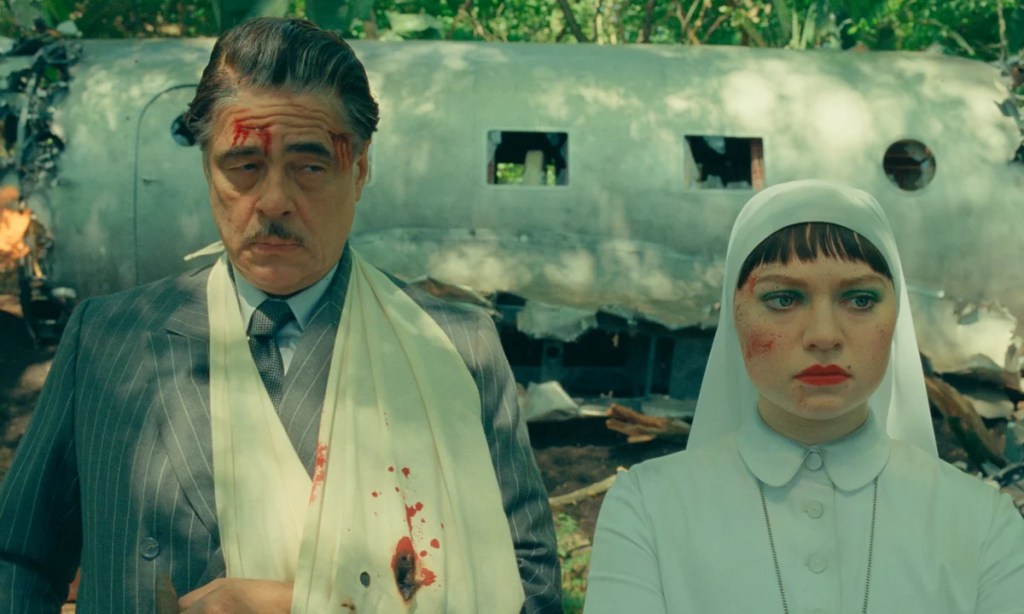
Wes Anderson’s 12th cinematic release follows the story of a wealthy businessman ‘Zsa-Zsa Korda’ (Benicio Del Toro) who has recently been faced with several assassination attempts against him. In a state of desperation, he appoints his daughter ‘Sister Liesl’ (Mia Threapleton) as the sole heir to his estate.
As you would expect from any Wes Anderson film, we are gifted with stunningly symmetrical shots, witty narrative, and a whimsically and beautifully coloured canvas. Anderson cannot be faulted for he continuously creates a piece that is visually pleasing to immerse yourself into. However, when watching this film, I wasn’t as engaged as I wanted to be.
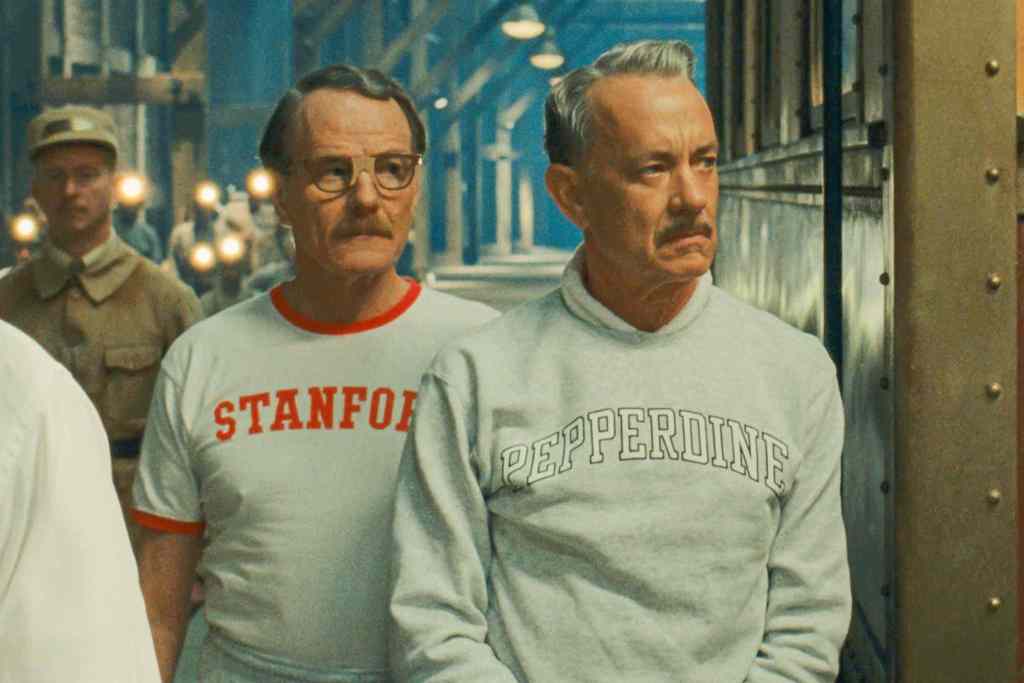
I recently rewatched ‘The Grand Budapest Hotel‘, and the humor, characters, direction, plot, and cinematography is unmatched. ‘The Phoenician Scheme‘ seemed to lack something. It felt like the only redeeming quality of the film was Micheal Cera coming out of his nerd type casting shell, and Tom Hanks and Bryan Cranston being an iconic basketball duo.
I found it very hard to connect with the characters and thought the dialogue was cold and blunt. The script was quite bland, stiff nothing powerful stood out to me. Maybe it was the tone illustrated by Mia Threapleton and Benicio Del Toro’s characters, obviously this was a directorial decision, but I wasn’t engaged with their attitude. There were a few witty comical moments that had a few chuckles in the screening I saw it in whereas, in the showing of ‘The Grand Budapest Hotel‘, there were ample reactions to the story and Ralph Fiennes’ natural ability to make the audience laugh.
The plot felt unpolished and monotonous. I struggled to follow the characters’ adventures and honestly didn’t have a clue as to what was going on and couldn’t establish the point of the story. It felt lifeless and in one ear, out the other kind of experience. Nothing stuck with me. I wasn’t hooked with the story and I didn’t leave the cinema thinking about the vast impact it had on me. I found myself checking the time and that’s the last thing you’d want to do in a cinema. I want to submerge myself into this fictional world and become one with the film, not wondering how long left I have to sit through it.
Anderson’s films often include an abundance of characters who we are briefly introduced to and never shown again. This can be impactful to the story in certain ways of storytelling and can add important elements as it unfolds. However, in ‘The Phoenician Scheme‘ we are introduced to an additional nine characters as well as the main protagonist. This felt useless because they weren’t given enough screen time for the audience to understand their purpose in the story. The minor extra characters were played by famous, well-known actors including; Tom Hanks, Bryan Cranston, Michael Cera, Scarlett Johansson, and Benedict Cumberbatch. Followed by a brief glimpse of Willem Dafoe as Knave and Bill Murray as God. The constant introduction of insignificant characters makes the story more confusing and harder to follow when they’re on screen for less than two minutes.
These famous actors have previously worked with Anderson, and it begins to feel like they’ve been given an impactless role for the sake of it and that it’s Wes Anderson. Almost like Anderson feels he is obliged to give them a small role, because he has cast them in pretty much every one of his films. I feel like this film would’ve got its story addressed to the audience more clearly and less incoherently if there were fewer characters involved.
On the contrary, Anderson undoubtedly showcases his incredibly unique skills in filmmaking. After all, he is The Wes Anderson. He uses a range of different engrossing camera techniques, for example, he directs the camera 90℃ and whips the camera back and forth between characters who are speaking. Additionally, he employs intense zooms and deep focus on a significant moment, character, or object. This varied range of camera shots helps to make a scene engaging and avoids cutting scenes that can make moments feel unfinished and edited. Further, Anderson perfectly exemplifies the idea that cinema is a work of art. He also uses tableau shots throughout The Phoenician Scheme, and his other work, which often mimics the design of paintings. He achieves this by placing characters in a certain way in the shot.
For example:
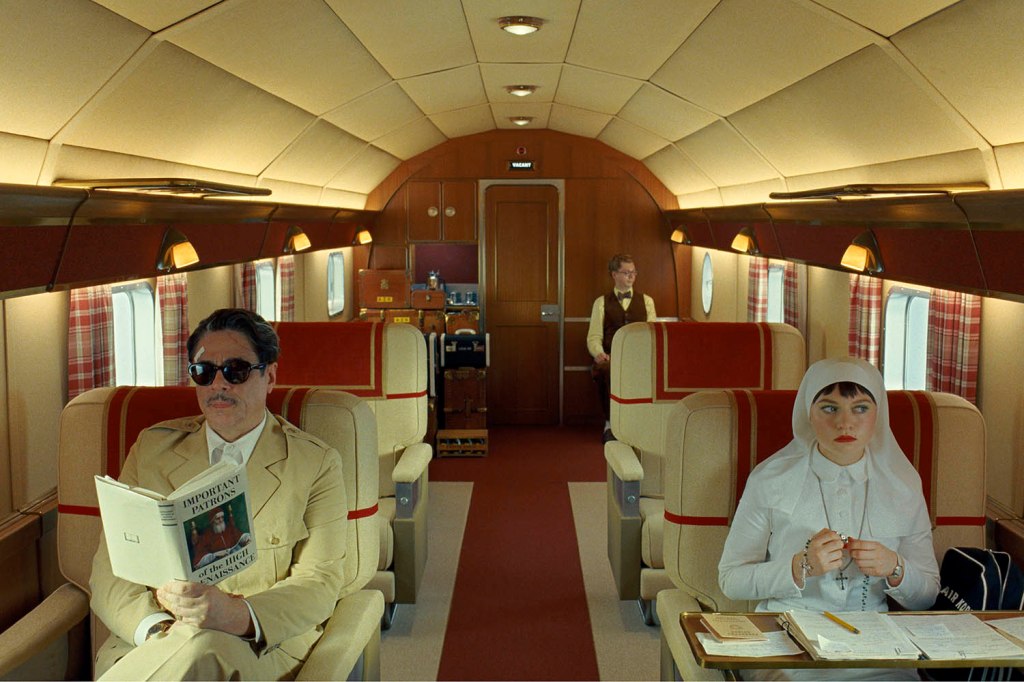
Similarly, how he directs the characters to act appears to be almost choreographed, as if the actors are impersonating stop-motion animation. This makes his method of characterization more theatrical, more captivating, and unique because the audience begins to focus their attention on their movements as well as their speech.
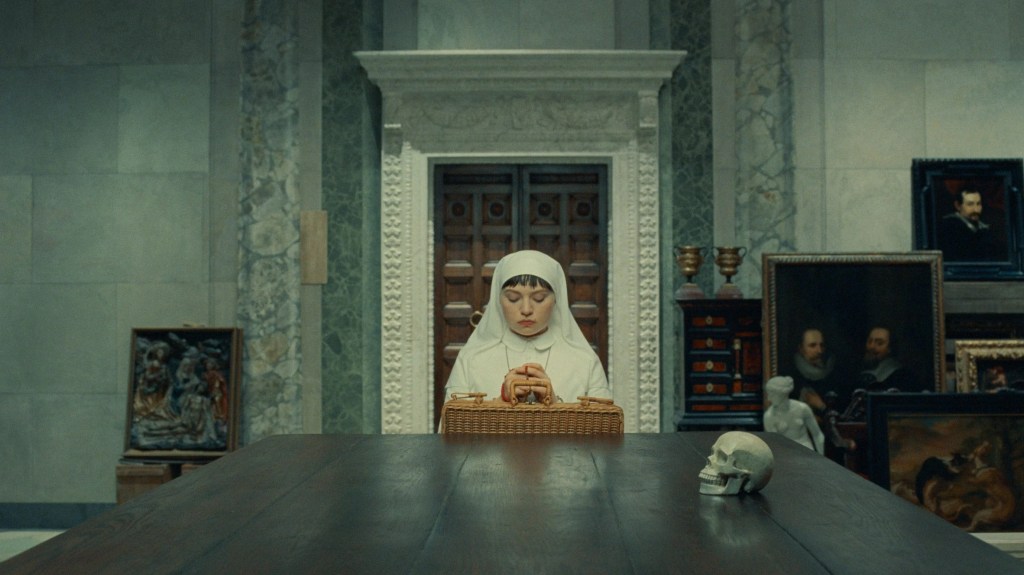
During the end credits, Anderson includes the artwork and artist he used in his film. I thought this was an amiable and creditable touch to add. He is not just crediting his work and those involved but, also including those who made his film artistic and admirable. This made watching this film feel like touring a museum. Every set and scene was so perfectly placed and organised in a way that makes viewing easier for the audience.
Moreover, Anderson’s set design is also extremely individual and unusual. He successfully creates a vision of a two-dimensional world; this mirrors the notion that cinema is artistry. His designs in ‘The Phoenician Scheme’ are intricate and place a large focus on attention to detail, from the wallpaper to furniture, props, and costumes. He builds his fictional worlds into real-life settings, for example, the scene in the desert. This is a unique way of locating film scenes because most scenes are shot in real-life locations or a studio, but he can craft and weave his imagination into life. This makes the shots visually pleasing to witness and indulge in. The use of colours in this film, like green, beige, orange, and grey creates a feeling of nostalgia. Colours of the 70s. The palette used is very eye-catching, yet neutral and charming. These calm, soft and subtle colours could mirror the life that Zsa-Zsa Korda and Sister Liesl were destined to have.
The ending was a touching and warm nod to the importance of father-daughter relationships. The audience is shown that after everything, he decides to give up on wealth spend time with his daughter, and focus on the simple things in life, like playing cards together and turns to a social and people oriented job as we are shown that he now works in a small cafe.
Overall, this isn’t Anderson’s strongest release. Yes, it was visually appealing and I will always appreciate and be in awe of Anderson’s craft as an individual and unique director. However, there could be room for improvement within the scripting and the direction of the plot.


Leave a comment