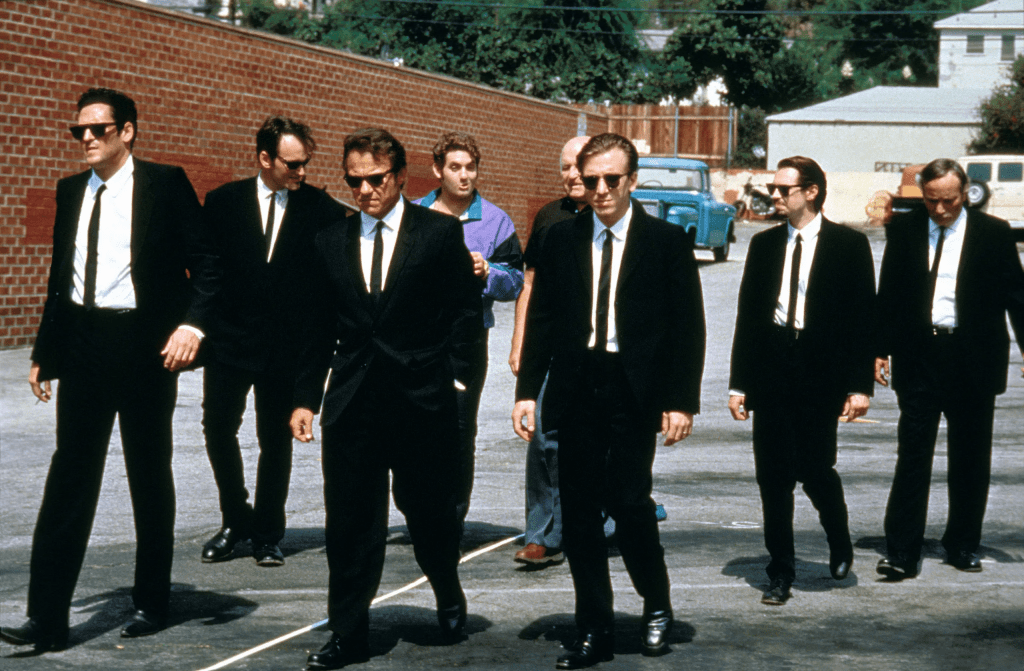
“You shoot me in a dream, you better wake up and apologise.”
⭐Ratings
- Director: Quentin Tarantino
- Starring: Harvey Keitel, Tim Roth, Chris Penn, Steve Buscemi & Michael Madsen
- Release date: 25 June 1992
- Where to watch: https://www.justwatch.com/uk/movie/reservoir-dogs
WARNING: CONTAINS SPOILERS
Quentin Tarantino’s 1992 debut Reservoir Dogs directly reveals who he is as a filmmaker, scriptwriter and director. He boldly changes the narrative for crime/gangster/thriller films, making Reservoir Dogs incredibly unique for its time.
Before the release of this film, popular action heavy films dominated the cinema including classics like; ‘Blade Runner’, ‘Scarface’, ‘Terminator’, ‘Die Hard’, ‘Batman’ and many more. Reservoir Dogs is the principle in changing gangster films as a genre, it includes little action and is quite literally dialogue-based. It focuses on building characters for the duration of the film. You would expect this to make it boring and make the film very slow but the magic of Tarantino is that it’s the complete opposite.
Harvey Keitel’s involvement in this film helped secure his role as ‘Mr. White’. After reading the script, he provided substantial funding to aid the casting of upcoming talent Tim Roth and Steve Buscemi. It is also known that before Keitel’s help, Reservoir Dogs was to be made on a minimal budget and to be shot in black and white to decrease costs. Yet, Keitel saw a unique talent in Tarantino and decided to become a producer of the film. Since then, he has starred in other work from Tarantino such as ‘Pulp Fiction’ and a voice role in ‘Inglorious Basterds’.
If the opening scene doesn’t scream Tarantino then I don’t know what does. The simplicity of having the main protagonists talking about the meaning behind Madonna’s Like A Virgin and whether to tip waitresses or not is unconventional and an unexpected opening to a film about gangsters. It feels like you’ve clicked play on the wrong film or like you don’t know what you’ve got yourself into or what to expect throughout. You almost start to question “Where is this going?” but it goes somewhere completely unforeseen. We are instantly shown the relationship between the eight characters and we begin to make an assumption of how and why these characters are connected such as; they are a group of friends. However, as the story develops we learn they are given an anonymous identity; ‘Mr. White’, ‘Mr. Pink’, ‘Mr Blonde’, ‘Mr. Brown’, ‘Mr Orange’ and ‘Mr Blue’. Each character is given a segment of the film to explain their backstory and how/why they ended up in this situation of carrying out a robbery planned and led by Lawrence Tierney’s character ‘Joe Cabot’.
Tarantino’s ingenious use of dialogue makes this film distinctive by drawing away from heavy and unnecessary action, the audience is instantly drawn towards the story as opposed to crazy stunts and intense fight sequences. This reinforces Tarantino’s message that any genre, specifically thriller, can be just as thrilling without the action.
The casting of ‘Reservoir Dogs’ proves that these talented and spritely actors saw something special and individual in Tarantino’s directory style. They trusted him to turn a gangster story into something eccentric and almost create an entire new genre. Casting for a film comes across as personal, especially because Tarantino is known for writing characters with a specific actor in mind and has a vision for the perfect actor and their perfect role. Much like Steve Buscemi. His performance really stood out to me, his line delivery was unmatched and purely effortless and that drew me to his character. His arguments were justified and his anger and annoyance was believable based on his circumstances.
Tim Roth was also amazing at playing someone slowly and painfully dying for an hour and forty minutes so hats off to Mr Roth. He was also great at making his story behind working for the group of gangsters unforeseen, because he turns out to be a covert cop, the audience are rooting for him to uncover their involvement to recent robberies. The fact that he managed Mr White to reveal his true identity as ‘Larry’ is incredibly sneaky and clever to gain personal information in a state of vulnerability (being shot in the stomach). We as the audience are led to believe that he was a smart and tactile cop and was obviously given this task to join their group for a reason, making his death tragic.
Michael Madsen played the psychotic and callous ‘Mr. Blonde’. When he joins Mr White, Mr Pink and Mr Orange he brings along a cop from the crime scene. Madsen effortlessly plays a cold-blooded and insane criminal when we are shown the infamous torture scene. He successfully plays someone insensitive and brutal from start to finish. ‘Stuck In The Middle With You’ sounds in the background of this shot. The use of music shows that his character is not new to this violent behaviour and it is simply a household chore for him with the casual radio in the background.
Since the release of this film, Tarantino was massively and widely criticised for displaying graphic and uncensored blood, gore and violence. Yes, this film is gorey and offensive but on some level it is real. Obviously being shot isn’t very pretty but it will involve a pool of blood. Tarantino has said in an interview about ‘Kill Bill’ when challenged about the continuous inclusion of “unnecessary” violence that he uses it “because it’s fun!” and that this type of behaviour happens in fictional movies that are made to entertain and turn something unrealistic into a fun film.
Movies are a creative way of expressing visions and imagination, like books and comics and drawings. Films are exactly the same. In my opinion, I don’t think Tarantino’s criticisms are justified. Yes, it can teach younger children inappropriate behaviour but graphic movies are given a high age rating for a reason. It is up to the view to decide how they react to what they are watching and whether they believe it to be wrong and immoral. Tarantino created these cunning and criminal characters to portray his vision of how people involved in a planned robbery would behave and react. That is the brilliance of fictional storytelling, it isn’t real.
When watching dialogue focused films I would catch myself saying, “That’s very Tarantino” and as a director, that takes a lot of skill, passion and knowledge to achieve your own trademark. Tarantino is also renowned for his excellent taste and use of music in his films. In Reservoir Dogs he uses icon classics such as ‘Stuck In the Middle With You’ by Stealer’s Wheels, ‘Hooked On A Feeling’ by Blue Suede and during the opening credits ‘Little Green Bag’ by George Baker Selection. His use of music is unmatched and perfectly crafted to suit the events taking place during the scene. Music in film can become very captivating and attach itself to that one well known scene. Anytime I listen to ‘Stuck In The Middle With You’ I instantly picture Michael Madsen walking across the warehouse before torturing the cop and that is the hook of this film. It is always recognised for that scene and that is very hard to achieve in a debut film.
In the finale of this film, Nice Guy Eddie, Joe and Mr. White are all pointing a gun at each other. This is a reference to Ringo Lam’s ‘City On Fire’ as three characters in his 1987 film are also all pointing a gun at each other. Mr White believes that Mr Orange is not an imposter, but Joe’s instincts say otherwise. Hence, they threaten each other and all end up dead. This underlines that you cannot trust anyone in this scenario.
Overall, Tarantino’s debut is an insight into what he has to offer in the film industry. He is creative, unique and will tell an entertaining story. His debut was closely followed by his 1994 hit ‘Pulp Fiction’ which truly showcased his powerful use of polished dialogue. Reservoir Dogs is a staple for who Tarantino is and this classic shadows his later work, showing his true passion lies in the influential use of words.

.

Leave a comment